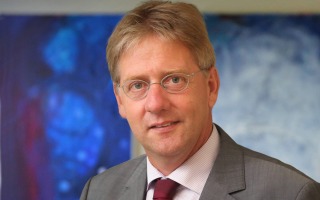
Special mini-tutorial: Anna I. Krylov, University of Southern California, Los Angeles, California 8 January, 2023 Mini Turtoial: The quantum chemistry of excited electronic states and open-shell species Anna I. Krylov, University of Southern California, Los Angeles, California Sunday, January 8, 2023, 10:00-13:00 AM, Los Angeles Seminar Room
Fritz Haber Seminar: Anna I. Krylov, University of Southern California, Los Angeles, California 5 January, 2023 States in the Continuum: Recent Progress in Non-Hermitian Quantum Chemistry Anna I. Krylov, University of Southern California, Los Angeles, California Thursday, January 5, 2023, 11:00 AM, Los Angeles Seminar Room
Fritz Haber Seminar: Yaron Amouyal, Technion - Israel Institute of Technology 29 December, 2022 New frontiers in thermoelectric materials design for waste heat harvesting Yaron Amouyal, Technion - Israel Institute of Technology Thursday, December 29, 2022, 11:00 AM, Los Angeles Seminar Room
Fritz Haber Seminar: David J. Tannor, Weizmann Institute of Science, Rehovot, Israel 15 December, 2022 Two Hundred Years after Hamilton: Exploring New Formulations of Classical and Quantum Mechanics David J. Tannor, Weizmann Institute of Science, Rehovot, Israel Thursday, December 15, 2022, 11:00 AM, Los Angeles Seminar Room
Fritz Haber Seminar: Tim Gould Griffith University, Queensland, Australia 12 December, 2022 Electronic structure of excited states (a mathematical treasure trove from ensemble density functional theory) Tim Gould, Griffith University, Queensland, Australia Monday, December 12, 2022, 14:30 AM, Los Angeles Seminar Room
Fritz Haber Seminar: Dr. Ryan Tyler Requist, Fritz Haber Center Institute of Chemistry, Israel 8 December, 2022 Non-Adiabatic density functional theory: putting electrons and nuclei on equal footing Ryan Tyler Requist, Fritz Haber Center Institute of Chemistry, Israel Thursday, December 8, 2022, 11 AM, Los Angeles Seminar Room
A symposium celebrating Gerard Meijer's Degree of Doctor Philosophiae Honoris Causa 12 June, 2022 A symposium celebrating Gerard Meijer's Degree of Doctor Philosophiae Honoris Causa
Fritz Haber Seminar: Eberhard K.U. Gross, Fritz Haber Center Institute of Chemistry, Israel 28 October, 2021 The exact factorization part II: Molecular Berry phases and the ab-initio description of phonon-mediated superconductivity Eberhard K.U. Gross, Fritz Haber Center Institute of Chemistry, Israel Thursday, October 28, 2021, 11 AM, Los Angeles Seminar Room Abstract
Fritz Haber Seminar: Eberhard K.U. Gross, Fritz Haber Center Institute of Chemistry, Israel 14 October, 2021 The exact factorization part I: Non-adiabatic molecular dynamic Eberhard K.U. Gross, Fritz Haber Center Institute of Chemistry, Israel Thursday, October 14, 2021 at 11 AM at Casali 253 Abstract
Fritz Haber Seminar: Stefan T. Bromley, University of Barcelona, Spain 27 May, 2021 Nanoscale Silicate Stardust: Astrochemical Relevance and Observational Signatures Stefan T. Bromley, Institute of Theoretical and Computational Chemistry, University of Barcelona, Spain Abstract